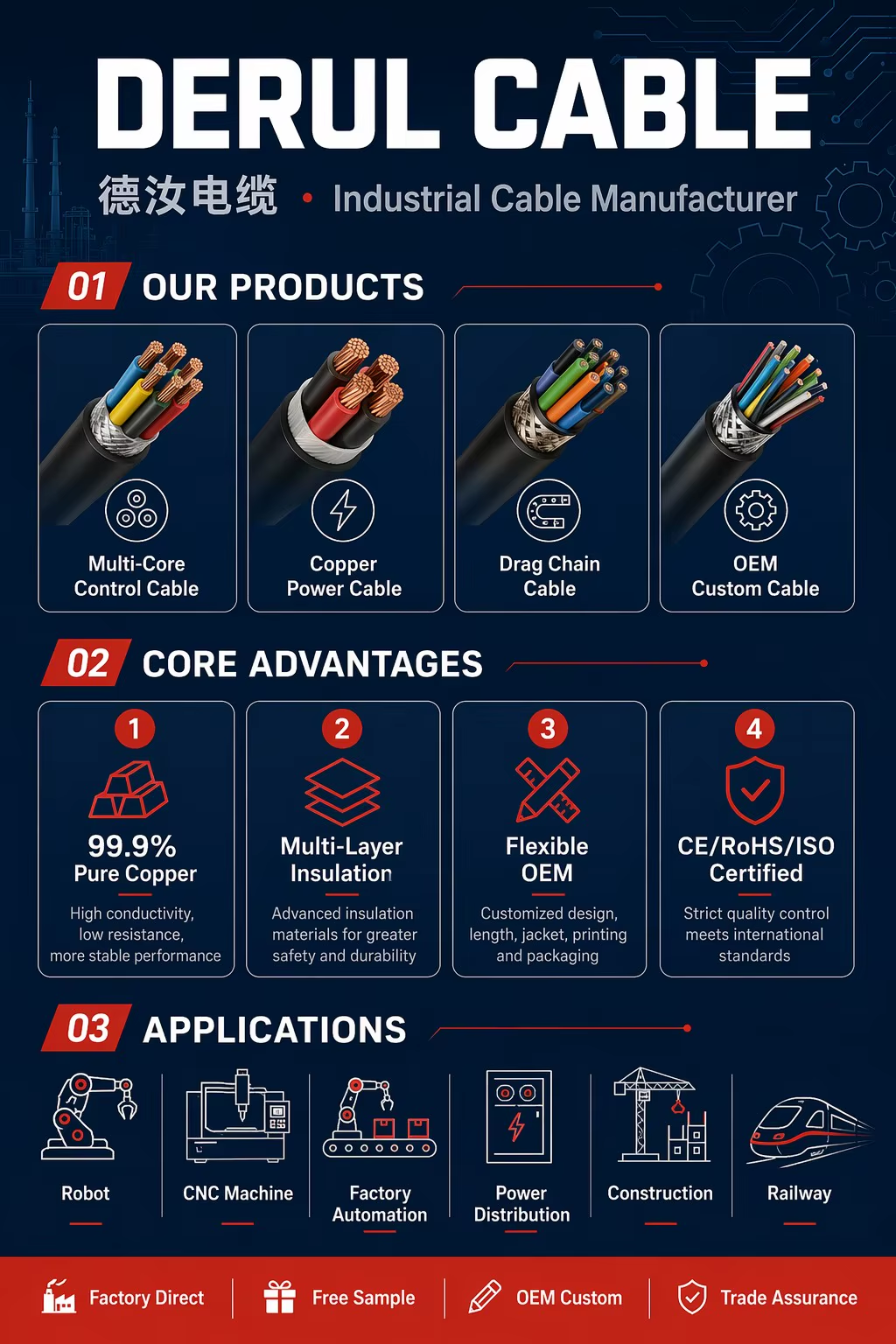
Robot Drag Chain Cable High Flexibility PUR Shielded Servo Cable for Industrial Robot CNC Machine Automated Production Line
Specification
| Basic Structure | Conductor+Insulation+Jacket+Hose |
| Conductor | Plain Copper/ Tinned Copper |
| Insulation | PE |
| Braid | Kevlar/ Plain Copper/ Tinned Copper |
| Jacket | PUR/TPE/PCP |
INTRODUCTION
An export robot drag chain cable is a high-flexibility, PUR-jacketed, shielded cable engineered for the continuous bending and torsional motion of industrial robots and CNC machines. The three non-negotiable features are: high flexibility (Class 5/6 ultra-fine copper stranding for 10+ million bending cycles), PUR jacket (oil, coolant, and abrasion resistance), and shielding (≥ 85% copper braid for clean servo and encoder signals). For export buyers, the same structural quality must come with international certifications (CE, RoHS, UL/CSA), consistent batch quality, and reliable lead times.

A servo cable carries power and encoder/signal feedback to servo motors. In robot applications, the cable flexes at every joint, at high speed, in tight radii. If the conductor stranding is wrong, bending stress concentrates on a few thick wires and they fatigue-break quickly — the classic "3-month cable failure."
What makes a cable truly flexible:
Class 5 / Class 6 conductors (IEC 60228 / VDE 0295) — the finer the individual strands, the better the fatigue resistance
Concentric counter-rotation stranding — inner layer twisted clockwise, outer layer counter-clockwise, so layers compensate stress during bending
Optimized stranding pitch — short, uniform pitch distributes stress evenly along the cable
Buffer filling layer — keeps cores separated so they do not rub against each other

The robot working environment is harsh: cutting fluid, hydraulic oil, chips, sparks, and temperature swings. A PUR (polyurethane) jacket is the industry-preferred solution because it delivers:
Oil and cutting-fluid resistance — survives coolant spray and oil mist day after day
Abrasion and wear resistance — withstands constant friction inside the cable carrier
Low-temperature flexibility — remains flexible down to about -40°C
Aging and UV resistance — longer service life in demanding plants
For dry, clean, light-duty applications, modified PVC is a cost-down alternative — but for robots and CNC machines, PUR is the safe default.

Define bending life — total cycles over machine lifetime, then choose one grade higher
Confirm signal types — servo/encoder/EtherCAT require shielded twisted pairs
Check the environment — oil and coolant → PUR jacket
Measure the bending radius — fit the drag chain with 10-20% margin
Request documentation — standards compliance, test reports, certifications


Q1: What is the difference between a robot cable and a drag chain cable? Robot cables are a subset of drag chain cables optimized for the higher speed, tighter radii, and torsional stress of robot joints. Both need high-flex stranding; robot grades usually specify 10+ million bending cycles and servo-grade shielding.
Q2: Why does my servo cable keep causing alarms? In most cases, the shielding is insufficient or the cable is flexing beyond its rated radius. Use a shielded servo cable with ≥ 85% braid density, verify the installed bending radius, and check that power and signal cores are properly separated.
Q3: Is PUR jacket necessary for drag chain cables? For machines exposed to oil, coolant, or low temperatures — yes. PUR resists oil, abrasion, and cold down to about -40°C. For clean dry environments, modified PVC is a lower-cost alternative.
Q4: How many bending cycles should a robot drag chain cable last? High-flex grades are rated for 10 million cycles or more; ultra-long life grades reach 20 million+. Always request the test report with the exact test conditions.
An export-grade robot drag chain cable with high flexibility, PUR jacket, and shielded construction is the reliable backbone for industrial robots and CNC machines. Match the bending-life grade to your application, verify shielding for servo signals, and choose a supplier that provides test reports and export certifications — that is how you avoid repeated cable failures and downtime.
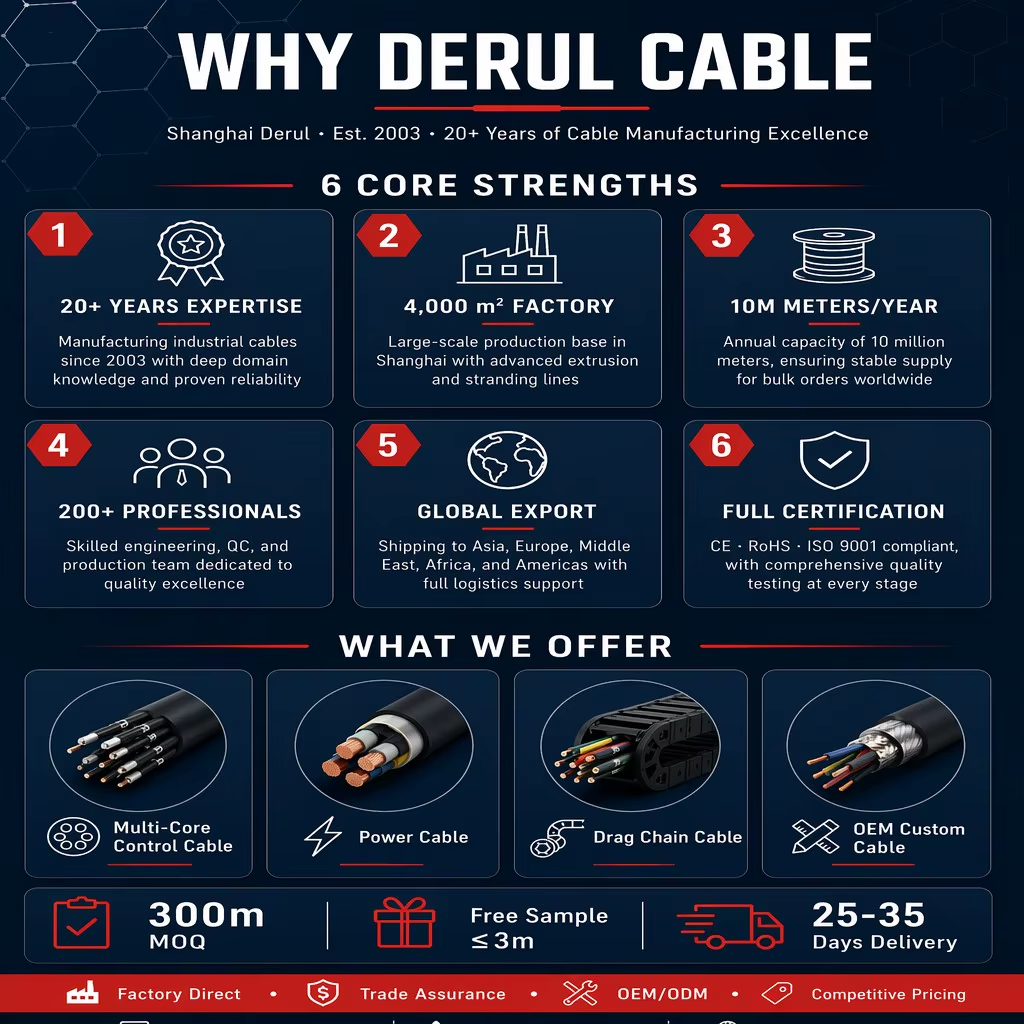
Need samples, test reports, or export quotations? Contact [Shanghai Deru Cable] — a specialist in high-flex robot drag chain cables with Class 6 conductors, PUR jackets, and ≥ 85% shielded constructions, exported worldwide with CE/RoHS/UL compliance.
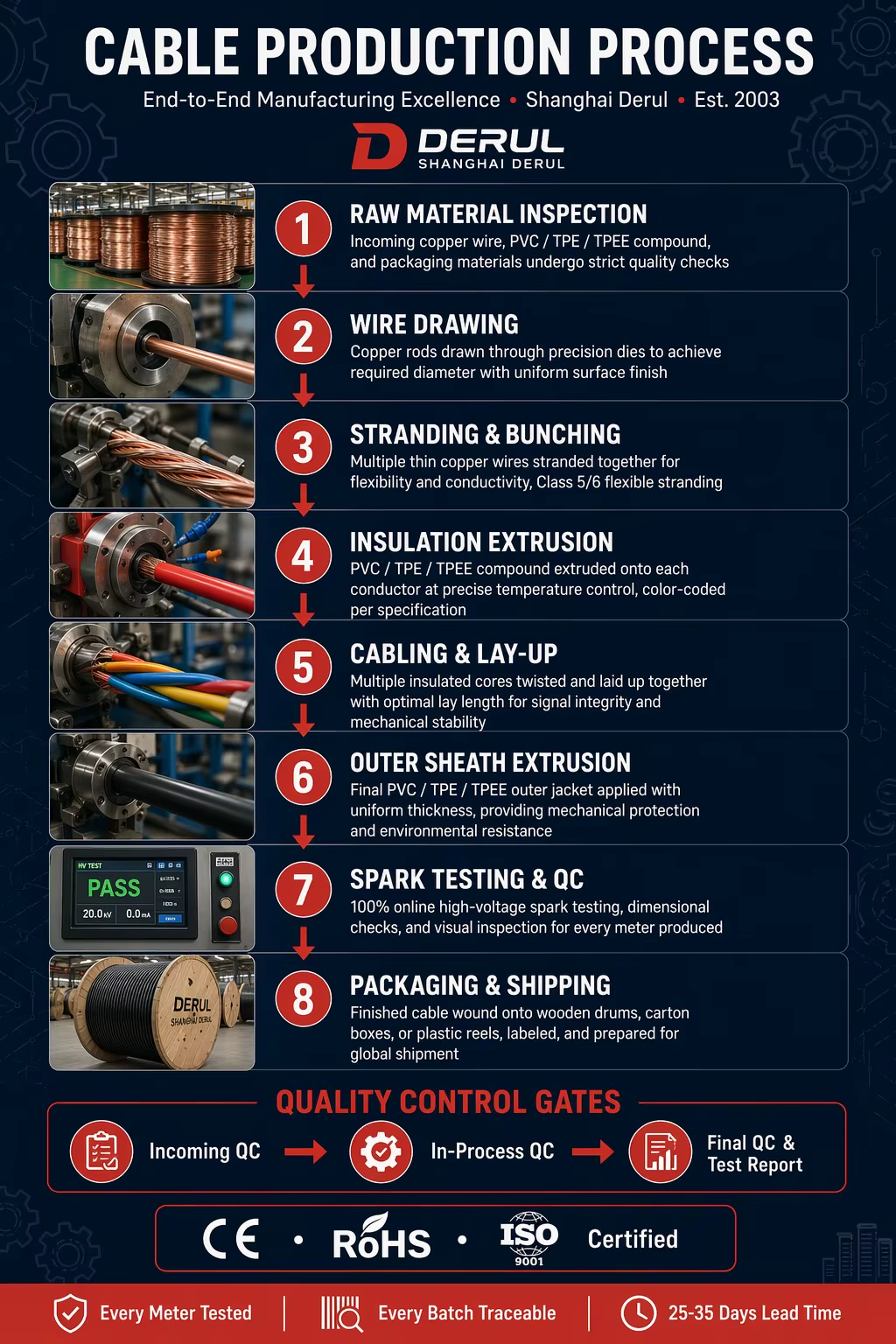
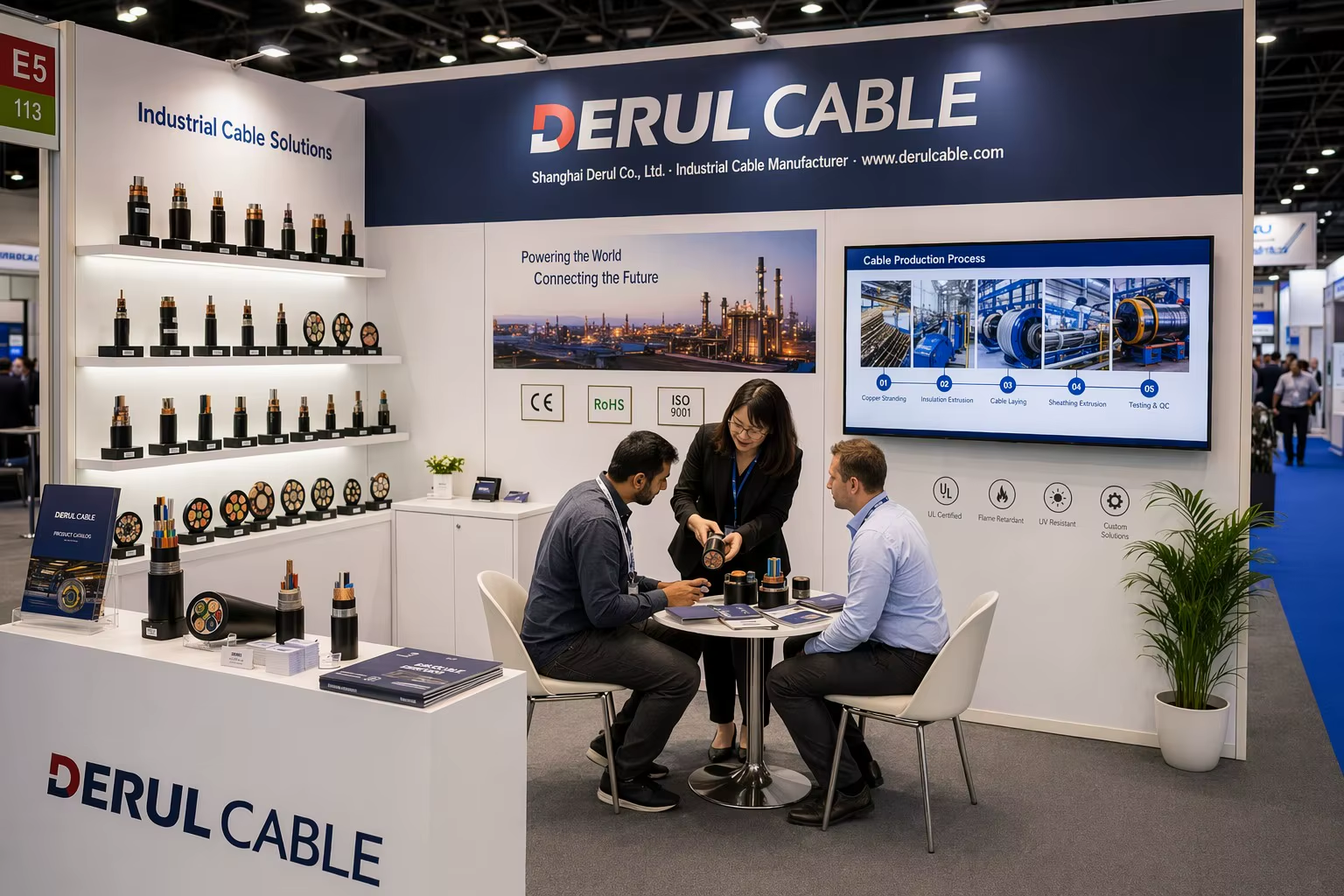
ADVANTAGES
Drag Chain Cable — Key Features
A drag chain cable (also called cable carrier cable or energy chain cable) is a special-purpose cable designed for continuous reciprocating motion inside cable carriers. Its key features:
1. Mechanical Performance
Ultra-high bending life: standard grades are rated for 5+ million bending cycles; high-flex grades for 10+ million; ultra-long-life grades for 20+ million, with some laboratory tests reaching 70 million cycles.
High-flexibility construction: Class 5/6 ultra-fine copper conductors (per IEC 60228 / VDE 0295) with concentric counter-rotation stranding, which distributes bending stress evenly and prevents core breakage.
Small bending radius: typically 7.5 to 10 times the cable outer diameter, allowing compact drag chain layouts.
Torsion resistance: withstands twisting and multi-directional motion common on robot arms and moving axes — something ordinary cables cannot handle.
2. Environmental Resistance (Jacket)
Abrasion and wear resistance: the jacket survives constant friction inside the cable carrier without damage.
Oil and cutting-fluid resistance: PUR jackets resist oil, coolant, and chemical corrosion in machine shop environments.
Low-temperature flexibility: PUR jackets remain flexible down to about -40°C.
Aging and UV resistance: longer service life outdoors and in hot, demanding plants.
3. Electrical Performance (Shielding)
EMI shielding: copper braid shields with 85% or higher braid density protect signal integrity near motors and drives.
Stable signal transmission: twisted pairs with an overall shield keep servo, encoder, and EtherCAT signals clean and free of packet loss.
Power and signal separation: internal layering prevents crosstalk between power cores and signal cores.
Voltage rating: typically 300/500V, with higher ratings available on request.
4. Structural Design — Why Premium Cables Last
Optimized stranding pitch: short, uniform pitch distributes bending stress evenly along the cable.
Buffer filling layer: cores are isolated from each other, so they do not rub or squeeze during bending.
Premium materials: oxygen-free or tinned copper conductors, special PE insulation, and a PUR jacket working together.
In one sentence: A drag chain cable combines a high-flexibility structure that survives millions of bending cycles, an oil- and abrasion-resistant PUR jacket, and interference-resistant shielding — purpose-built for the reciprocating motion of automated equipment.
FAQ
Q: Is Derul Cable the original manufacturer?
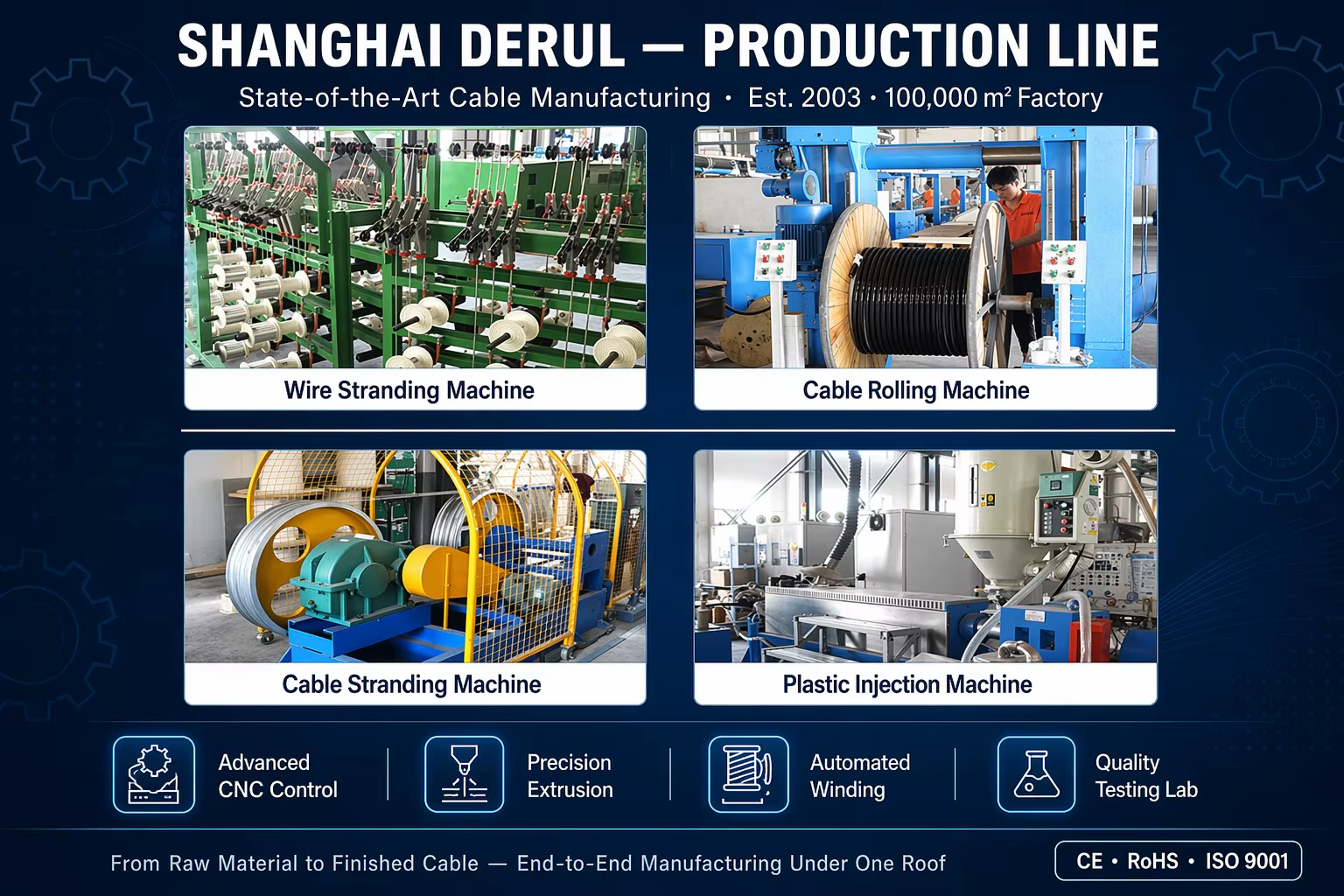
A: Derul Cable is a special cable manufacturer. Our factory is based in Shanghai.
Q: Is the price negotiable?
A: Yes, the price is negotiable. Our price is also flexible due to several factors including purchase quantity.
Q: What is the regular MOQ for your cable?
A: Any quantity is okay to purchase for product at stock. For product with no stock, its MOQ is usually 100-200 meters per type.
Q: How can I get sample?
A: Usually you only need to pay the express freight, and after your confirmation of the product dimension and structure, we can arrange the sample and send it directly to you.
Q: Is OEM or ODM service available?
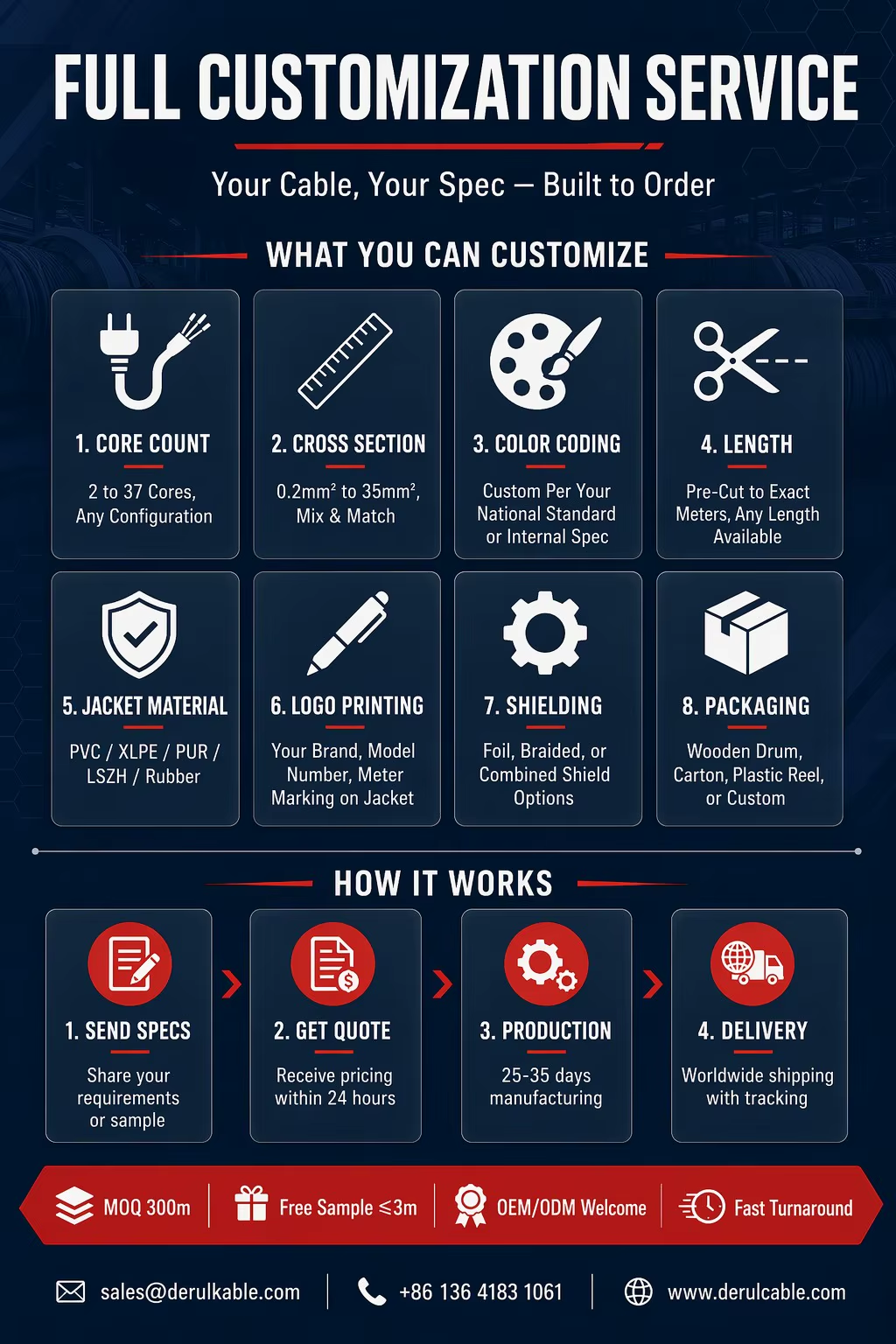
A: OEM and ODM services are both available. You can provide us with your requirement for the product and we will evaluate it to push forward.
Q: What is the regular production time?
A: For regular quantity, it usually costs about 15-25 days to produce.
Quick Links

WhatsApp: +86 13641831061
E-mail: sales@derulkable.com
Add.:No.236 Fenggao Road Fengxian District Shanghai China
Get in touch