High Flexible Drag Chain Cable PUR Jacket Shielded Control Cable for CNC Machine Robot Cable 10 Million Bending
Specification
| Basic Structure | Conductor+Insulation+Jacket+Hose |
| Conductor | Plain Copper/ Tinned Copper |
| Insulation | PE |
| Braid | Kevlar/ Plain Copper/ Tinned Copper |
| Jacket | PUR/TPE/PCP |
INTRODUCTION
A high flexible drag chain cable is a special-purpose cable engineered for continuous bending in cable carriers (drag chains). The three features that matter most are: PUR jacket (oil, abrasion, and chemical resistance), shielded construction (electromagnetic interference protection for signal integrity), and bending life of 10 million cycles or more. If your CNC machine or industrial robot keeps failing cables every few months, the problem is almost never the machine — it is almost always the cable structure: wrong stranding, wrong jacket material, or no proper shielding.

A drag chain cable (also called cable carrier cable or energy chain cable) is installed inside a cable carrier that moves back and forth with machinery. Unlike stationary cables, drag chain cables must survive millions of repetitive bending cycles — from 5 million cycles for standard grades to 10 million and 20 million cycles for high-flex grades, with laboratory tests reaching up to 70 million cycles in some cases.
The key difference from ordinary cable is not "softness" — it is the ability to keep conductors unbroken, jacket uncracked, and performance stable under high-frequency bending.
The outer jacket is the cable's first line of defense. PUR (polyurethane) is the preferred jacket material for demanding industrial environments because it offers:
Excellent oil and cutting fluid resistance — survives machine shop coolant, hydraulic oil, and acid/alkali exposure
High abrasion and wear resistance — withstands constant friction inside the drag chain
Cold flexibility down to about -40°C — stays flexible in low-temperature applications
Aging and UV resistance — longer service life outdoors and in harsh plants
For comparison, modified PVC jackets cost less but offer only moderate oil resistance and abrasion performance — acceptable only in clean, dry, light-duty environments.

High flexible drag chain cables are widely used in:
Whether used as a power cable, control cable, or signal cable, the same structural rules apply: fine conductor stranding, proper shielding, and a PUR jacket.
When selecting a supplier, evaluate these 5 points:
[Shanghai Deru Cable] specializes in high flexible drag chain cables: Class 6 ultra-fine copper conductors, counter-rotation stranding, PUR jacket, and high-density shielding, available in 5M/10M/20M bending-cycle grades for industrial robots, CNC machines, and automated production lines. Contact us for samples and test reports.


Q1: What is the difference between a drag chain cable and a high flexible drag chain cable? A standard drag chain cable is rated for at least 5 million bending cycles; a high flexible grade is rated for 10 million or more, using finer Class 5/6 conductor stranding and premium jacket materials for higher fatigue resistance.
Q2: How many bending cycles can a drag chain cable achieve? Standard grades: ≥ 5 million. High-flex grades: ≥ 10 million. Ultra-long life grades: 20 million+, with some laboratory tests reaching 70 million cycles.
Q3: Why is a PUR jacket better than PVC for drag chain cables? PUR provides superior oil and cutting-fluid resistance, abrasion resistance, and low-temperature flexibility (down to about -40°C). PVC is cheaper but only moderate in these properties.
Q4: Do I need a shielded drag chain cable? If the cable carries servo, EtherCAT, PROFINET, CAN, or encoder signals near motors and drives, yes — use twisted pairs with a copper braid shield of ≥ 85% density to prevent EMI and signal loss.
A high flexible drag chain cable with a PUR jacket, shielded construction, and a 10-million-cycle bending rating is the reliable choice for CNC machines, industrial robots, and automated production lines. Match the cable grade to your bending-life requirement, verify the structure and test reports, and choose a supplier with real testing capability — that is how you avoid the "3-month cable" trap.
Need a sample, test report, or selection help? Contact [Shanghai Deru Cable] today.
ADVANTAGES
Drag Chain Cable — Key Features
A drag chain cable (also called cable carrier cable or energy chain cable) is a special-purpose cable designed for continuous reciprocating motion inside cable carriers. Its key features:
1. Mechanical Performance
Ultra-high bending life: standard grades are rated for 5+ million bending cycles; high-flex grades for 10+ million; ultra-long-life grades for 20+ million, with some laboratory tests reaching 70 million cycles.
High-flexibility construction: Class 5/6 ultra-fine copper conductors (per IEC 60228 / VDE 0295) with concentric counter-rotation stranding, which distributes bending stress evenly and prevents core breakage.
Small bending radius: typically 7.5 to 10 times the cable outer diameter, allowing compact drag chain layouts.
Torsion resistance: withstands twisting and multi-directional motion common on robot arms and moving axes — something ordinary cables cannot handle.
2. Environmental Resistance (Jacket)
Abrasion and wear resistance: the jacket survives constant friction inside the cable carrier without damage.
Oil and cutting-fluid resistance: PUR jackets resist oil, coolant, and chemical corrosion in machine shop environments.
Low-temperature flexibility: PUR jackets remain flexible down to about -40°C.
Aging and UV resistance: longer service life outdoors and in hot, demanding plants.
3. Electrical Performance (Shielding)
EMI shielding: copper braid shields with 85% or higher braid density protect signal integrity near motors and drives.
Stable signal transmission: twisted pairs with an overall shield keep servo, encoder, and EtherCAT signals clean and free of packet loss.
Power and signal separation: internal layering prevents crosstalk between power cores and signal cores.
Voltage rating: typically 300/500V, with higher ratings available on request.
4. Structural Design — Why Premium Cables Last
Optimized stranding pitch: short, uniform pitch distributes bending stress evenly along the cable.
Buffer filling layer: cores are isolated from each other, so they do not rub or squeeze during bending.
Premium materials: oxygen-free or tinned copper conductors, special PE insulation, and a PUR jacket working together.
In one sentence: A drag chain cable combines a high-flexibility structure that survives millions of bending cycles, an oil- and abrasion-resistant PUR jacket, and interference-resistant shielding — purpose-built for the reciprocating motion of automated equipment.
FAQ
Q: Is Derul Cable the original manufacturer?
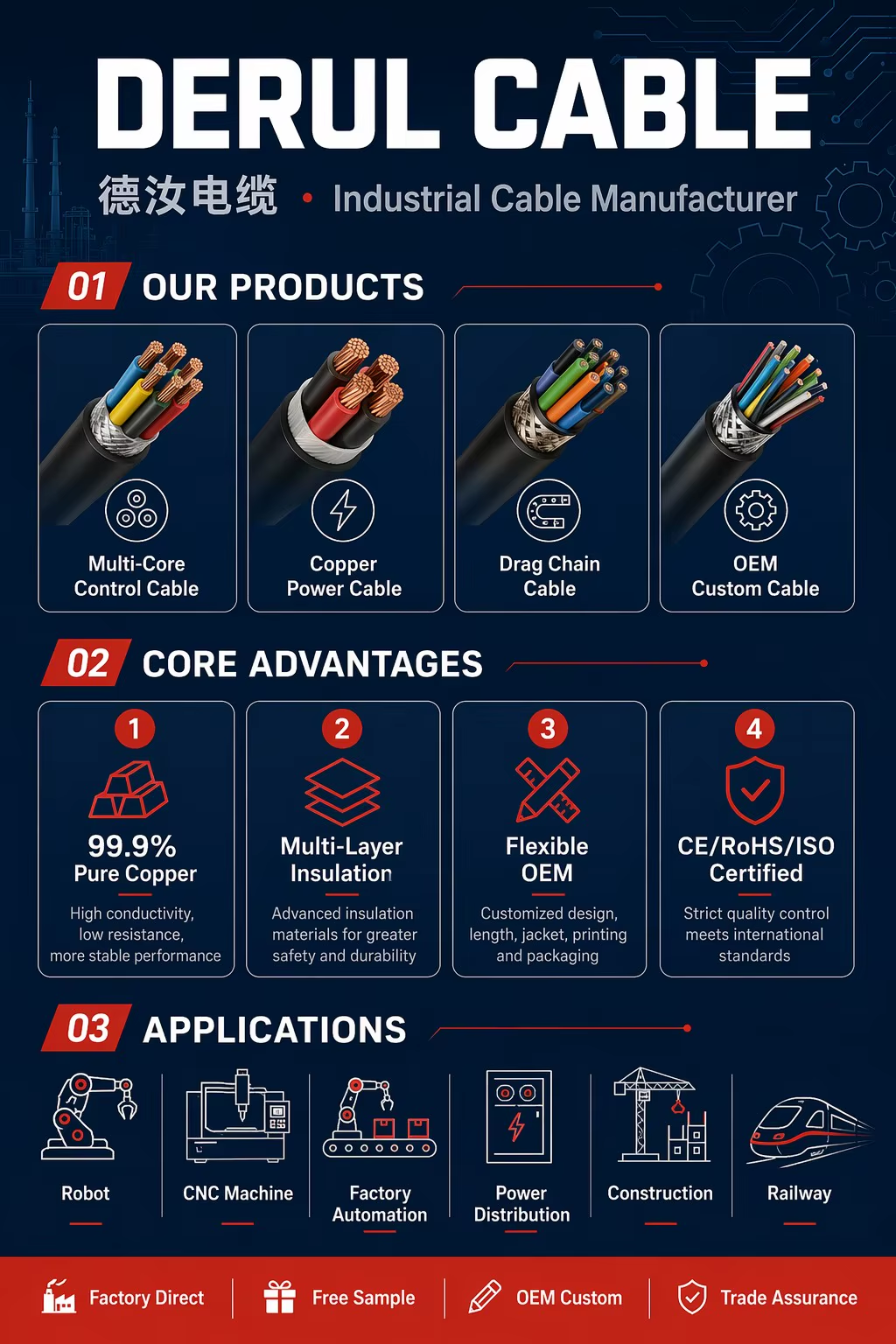
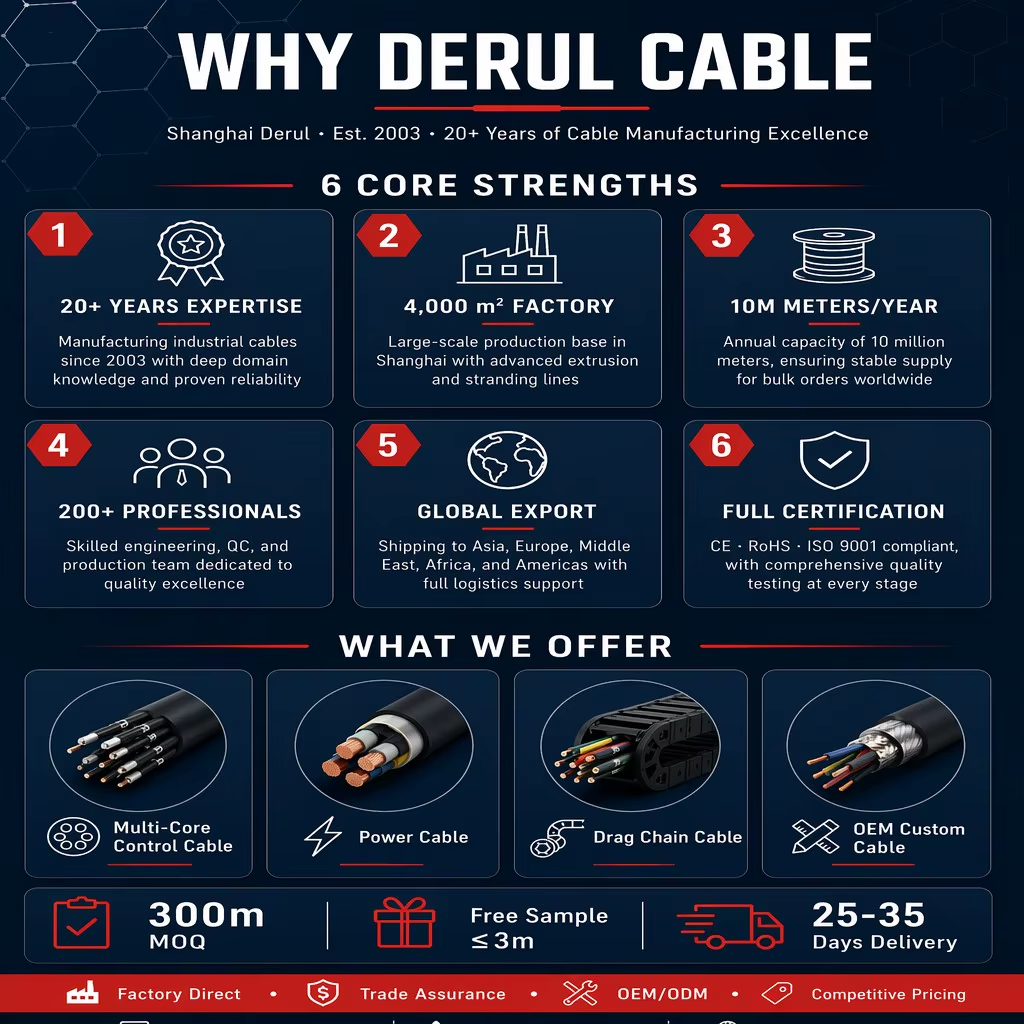
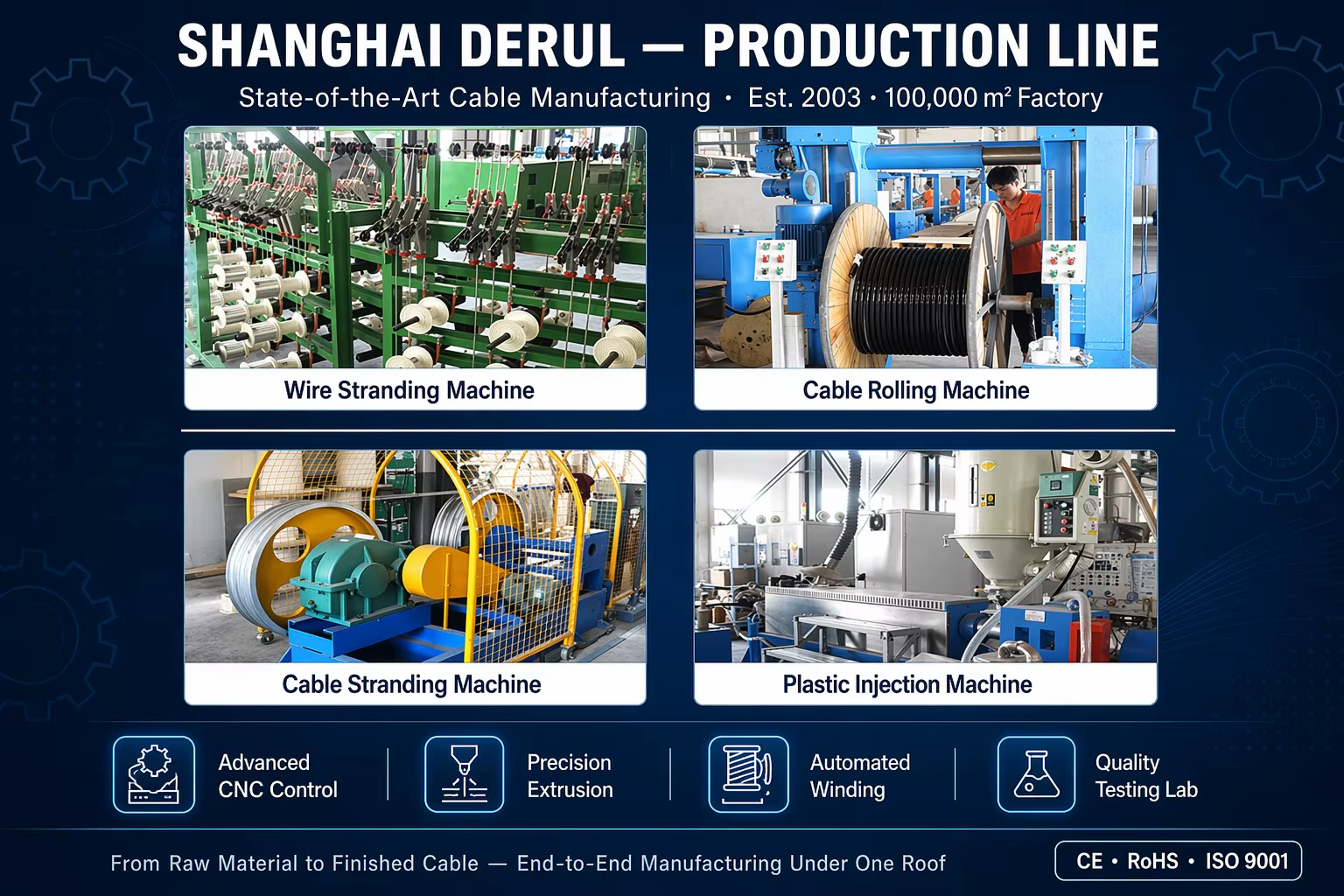
A: Derul Cable is a special cable manufacturer. Our factory is based in Shanghai.
Q: Is the price negotiable?
A: Yes, the price is negotiable. Our price is also flexible due to several factors including purchase quantity.
Q: What is the regular MOQ for your cable?
A: Any quantity is okay to purchase for product at stock. For product with no stock, its MOQ is usually 100-200 meters per type.
Q: How can I get sample?
A: Usually you only need to pay the express freight, and after your confirmation of the product dimension and structure, we can arrange the sample and send it directly to you.
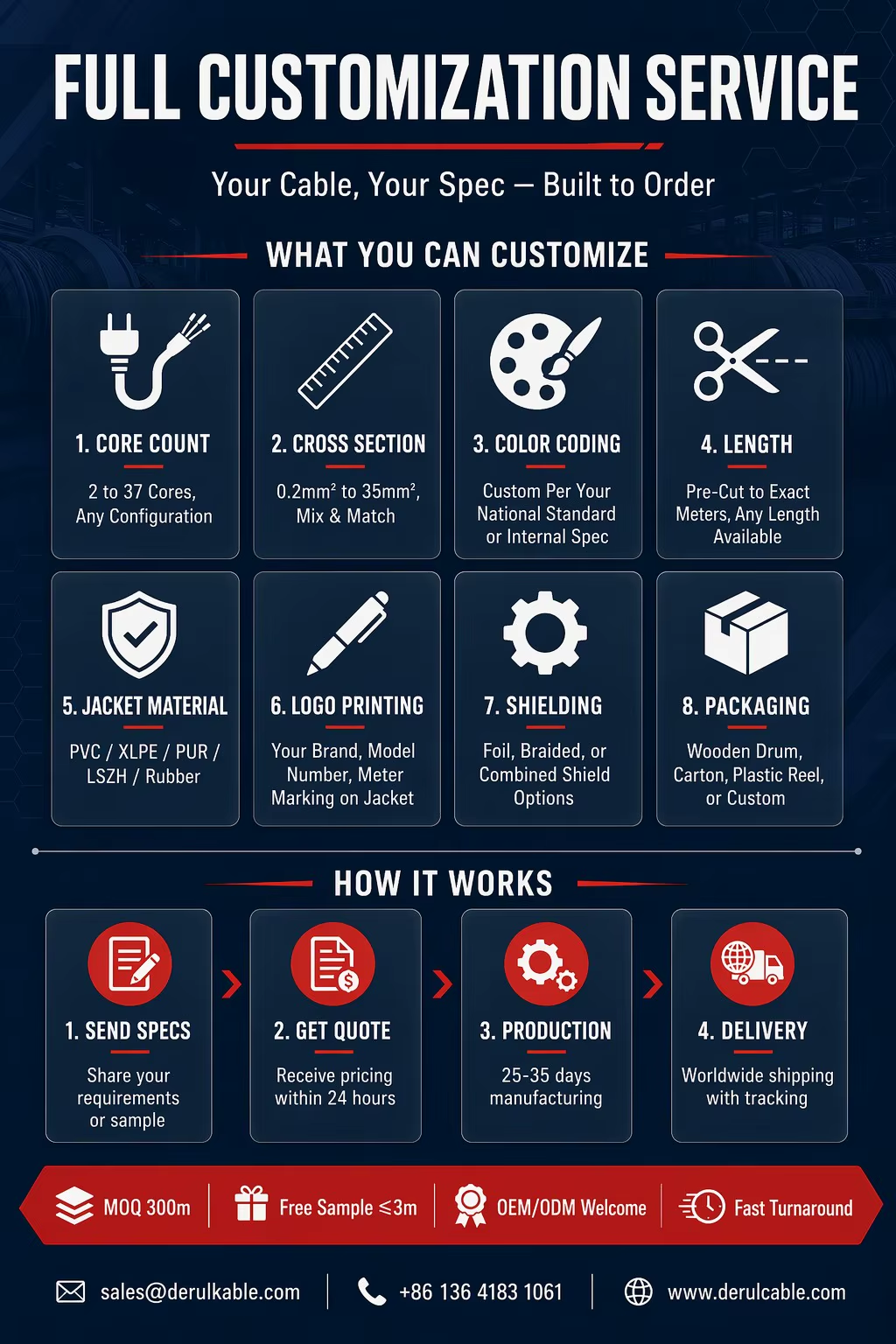
Q: Is OEM or ODM service available?
A: OEM and ODM services are both available. You can provide us with your requirement for the product and we will evaluate it to push forward.
Q: What is the regular production time?
A: For regular quantity, it usually costs about 15-25 days to produce.
Quick Links

WhatsApp: +86 13641831061
E-mail: sales@derulkable.com
Add.:No.236 Fenggao Road Fengxian District Shanghai China
Get in touch