Floating 3-Core Cable for Pool Cleaning Robots | Foamed PUR & PVC, 14 AWG | Shanghai Deru Cable
Specification
| Basic Structure | Conductor+Insulation+Jacket+Hose |
| Conductor | Plain Copper/ Tinned Copper |
| Insulation | PE |
| Braid | Kevlar/ Plain Copper/ Tinned Copper |
| Jacket | PUR/TPE/PCP |
INTRODUCTION
A floating 3-core cable for pool cleaning robots is a buoyant power cable that links the robot to its above-ground control unit. With 14 AWG tinned copper conductors and a foamed PUR or PVC jacket, it floats on the water surface — clear of ladders, skimmers, and pool walls — keeping the robot tangle-free throughout its cleaning cycle.
This guide covers how the cable is built, why buoyancy matters, foamed PUR vs. PVC, and what to specify as a replacement part or OEM/ODM component.

The floating cable is the tether between a submerged, self-propelled robot and its poolside control unit, carrying low-voltage DC power (and, on some models, communication signals). Its cellular (foamed) polymer construction gives it a specific gravity below 1.0, so it floats instead of sinking.
Why this matters:
Prevents tangling around ladders, skimmers, steps, and pool walls
No drag on the pool floor — the robot climbs walls and turns freely
Less abrasion and flex stress at the connector, extending cable life
Visible and easy to retrieve — the cable marks the robot's position

Takeaway: choose PUR when service life, saltwater, or cold climates matter; choose PVC when first cost dominates. Many programs offer both variants.

14 AWG equals 2.08 mm² of copper cross-section — the de facto standard for robotic pool cleaner cables:
Enough current capacity for typical low-voltage robot power, with minimal heating
Low voltage drop over common 15–20 m cable runs
Robust yet flexible — withstands repeated flexing and connector strain
Industry-compatible with major robot platforms and connectors
Tinned stranded copper for corrosion resistance in chlorinated or saltwater pools

Conductor — 14 AWG (2.08 mm²) stranded tinned copper [confirm stranding]
Core insulation — foamed polymer per core (main buoyancy source) with a solid skin for electrical integrity
Core identification — 3 colored cores [e.g., black/blue/brown]
Jacket — foamed PUR or foamed PVC, UV-stabilized, seals against water ingress
Optional — strain relief, printed length markings, custom colors

Chlorine — UV-stabilized PVC and especially PUR resist hardening and cracking
UV — the cable sits in direct sunlight; UV-stabilized compounds are essential
Saltwater — PUR jacket + tinned conductors is the recommended combination
Cold — PUR stays flexible; PVC stiffens, increasing bend stress at the connector
Flexing — stranded conductors plus an elastic jacket survive millions of flex cycles
Core count and function (power/signal)
Length matched to pool size and control-unit distance
Jacket: PUR for premium/saltwater/cold markets; PVC for cost-sensitive programs
Buoyancy confirmed (SG < 1.0 with your connector and length)
Connector interface (bare tinned ends or molded, per drawing)
Compliance (RoHS/REACH; target-market certs)

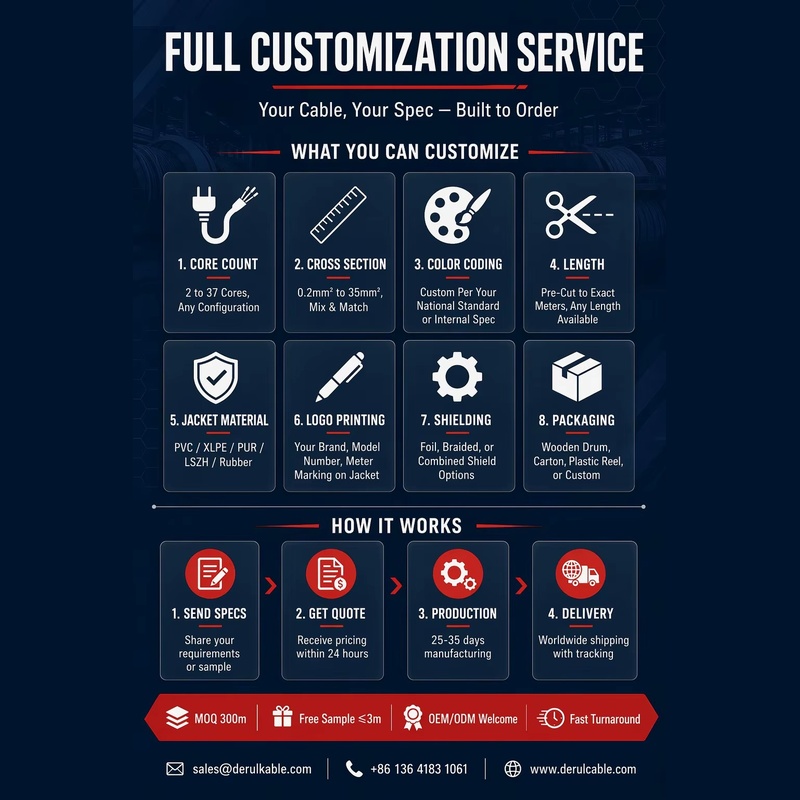
Custom lengths, core/jacket colors, molded connectors and strain relief per your drawings, custom printing (brand, length markers), dual-spec PUR/PVC programs, and retail-ready packaging. Send your drawing or sample and we will match construction, buoyancy, and connector interface to your robot platform.
Why does a pool robot cable need to float? It stays on the water surface, away from ladders, skimmers, and pool walls — preventing tangling, keeping the robot free to maneuver, and making it easy to locate and retrieve.
PUR or PVC — which jacket lasts longer? PUR. It resists abrasion, chlorine, UV, and cold stiffening far better. PVC is the economical choice for mild environments but hardens and cracks faster under prolonged chlorine and sunlight exposure.
What does "14 AWG" mean? 14 AWG is an American Wire Gauge size equal to 2.08 mm² of copper cross-section — the common conductor size for robotic pool cleaner cables, balancing current capacity, voltage drop, and flexibility over 15–20 m runs.
Can a floating cable be used in a saltwater pool? Yes, when specified correctly: a PUR jacket with UV stabilizers and tinned stranded copper conductors is the recommended combination for saltwater and chlorine-generator pools.
Can you customize cable length and connectors? Yes — custom lengths, bare tinned ends, or molded connectors per your drawing, as part of OEM/ODM supply.
ADVANTAGES
FAQ
Q: Is Derul Cable the original manufacturer?
A: Derul Cable is a special cable manufacturer. Our factory is based in Shanghai.
Q: Is the price negotiable?
A: Yes, the price is negotiable. Our price is also flexible due to several factors including purchase quantity.
Q: What is the regular MOQ for your cable?
A: Any quantity is okay to purchase for product at stock. For product with no stock, its MOQ is usually 100-200 meters per type.
Q: How can I get sample?
A: Usually you only need to pay the express freight, and after your confirmation of the product dimension and structure, we can arrange the sample and send it directly to you.
Q: Is OEM or ODM service available?
A: OEM and ODM services are both available. You can provide us with your requirement for the product and we will evaluate it to push forward.
Q: What is the regular production time?
A: For regular quantity, it usually costs about 15-25 days to produce.
HOT PRODUCT


Quick Links

WhatsApp: +86 13641831061
E-mail: sales@derulkable.com
Add.:No.236 Fenggao Road Fengxian District Shanghai China
Get in touch